

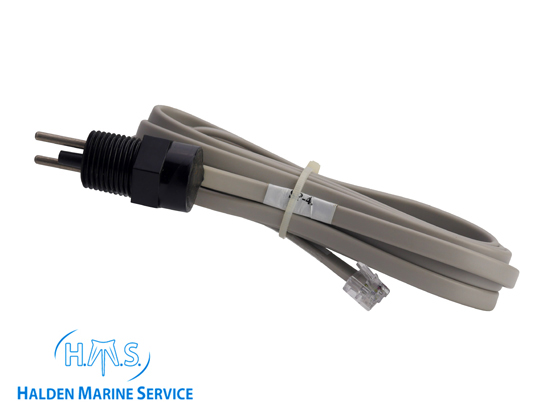
SALINITY PROBE 4TH GENERATION
Original price was: $228.00.$205.20Current price is: $205.20.
The salinity probe on Spectra Connect systems tests the salinity of the product water before deciding to accept and divert clean water to your tank. We offer replacement probes for all systems.
Spectra Watermaker Salinity Probe FAQs: Troubleshooting, High TDS Readings & Replacement
What does the salinity probe do on a Spectra Watermaker?
The Spectra salinity probe, also called the TDS (Total Dissolved Solids) sensor, continuously measures the quality of the fresh water your Spectra Watermaker produces.
As product water flows through the system, the salinity probe measures the amount of dissolved solids in the water. This reading is displayed as Total Dissolved Solids (TDS), usually expressed in parts per million (PPM).
The Spectra control system uses this information to:
- Monitor the quality of your product water.
- Display the TDS or PPM reading on the control panel.
- Help determine whether the water is suitable for drinking.
- Alert the operator if water quality falls outside acceptable limits.
As a general industry guideline, drinking water produced by a reverse osmosis watermaker should measure less than 500 PPM, although most properly functioning Spectra Watermakers produce water with much lower TDS levels.
Is a Spectra salinity probe the same as a handheld TDS meter?
Both devices perform the same basic function—they measure the Total Dissolved Solids (TDS) in your product water—but they serve different purposes.
The Spectra salinity probe is permanently installed inside the watermaker and continuously monitors water quality during operation.
A handheld TDS meter is a portable testing device that allows you to independently verify water quality at any time.
We recommend that every Spectra Watermaker owner, whether using a manual or fully automatic system, carry a quality handheld TDS meter onboard. It is one of the most valuable troubleshooting tools available because it allows you to verify the accuracy of the installed salinity probe and quickly determine whether a problem is caused by the sensor or by the watermaker itself.
How do I know if my Spectra salinity probe has failed?
The most common indication of a failed salinity probe is a “Salinity Probe Failed” alarm displayed on your Spectra control panel.
In our experience, when this alarm appears, the probe itself is the cause approximately 95% of the time and replacement is usually the correct solution.
Other signs of a failing salinity probe may include:
- No TDS or PPM reading on the display.
- Erratic or constantly changing salinity readings.
- Readings that do not agree with a handheld TDS meter.
- Repeated salinity probe fault alarms.
Before replacing the probe, inspect the electrical connector and wiring to ensure there are no loose or corroded connections.
Why is my Spectra Watermaker showing a high salinity or high TDS reading?
A high salinity reading does not automatically mean your reverse osmosis membrane has failed.
Several different problems can cause elevated TDS or PPM readings, including:
- A worn or fouled RO membrane.
- Low operating pressure.
- A worn Shurflo feed pump.
- A failing Clark Pump.
- Restricted seawater flow.
- Air entering the feed water system.
- Improper system operation.
- A contaminated or dirty salinity probe.
Because multiple components affect water quality, diagnosing high salinity often requires testing the entire system rather than replacing parts based solely on the TDS reading.
For this reason, we recommend troubleshooting the complete watermaker before assuming the membrane needs replacement. In many cases, the membrane is not the actual cause of the problem.
Can a dirty salinity probe cause false TDS readings?
Yes.
Over time, mineral deposits, biological growth, or other contaminants can accumulate on the probe and affect its ability to accurately measure water quality.
If the probe becomes contaminated, it may display incorrect TDS readings or trigger unnecessary salinity alarms.
Cleaning is straightforward:
- Remove the probe from the manifold.
- Gently polish the sensing surfaces using 400 to 600 grit wet/dry sandpaper.
- Rinse thoroughly with fresh water.
- Reinstall the probe and retest the system.
Avoid using aggressive abrasives or power tools, as they may damage the sensing elements.
Can a bad salinity probe affect my Spectra Watermaker’s performance?
The salinity probe does not directly affect the mechanical performance of your Spectra Watermaker.
It does not change:
- Feed pressure
- Clark Pump operation
- Water production
- Membrane performance
However, on fully automatic systems, a failed salinity probe may cause the controller to generate fault alarms or stop automatic operation.
Depending on your Spectra controller version, it may be possible to temporarily bypass or disable the salinity monitoring function while troubleshooting or waiting for a replacement probe.
If you’re unsure how to do this, contact a qualified Spectra Watermaker technician before making programming changes.
How do I test a Spectra Watermaker salinity probe?
One of the easiest ways to evaluate the salinity probe is to compare its readings with a handheld TDS meter.
If the probe is displaying stable and reasonable TDS values that closely match your handheld meter, it is generally operating correctly.
If the control panel displays no reading, highly erratic readings, or values that differ significantly from a handheld meter, further inspection or replacement may be necessary.
Comparing the installed probe with a handheld TDS meter is one of the fastest ways to determine whether the problem is the sensor or another component of the watermaker.
When should I replace the salinity probe on my Spectra Watermaker?
Unlike filters or pump components, the salinity probe does not have a scheduled replacement interval.
Replace the probe only when testing confirms it has failed or when the control system repeatedly reports a “Salinity Probe Failed” alarm.
The newer SP-4 salinity probes used on modern Spectra Watermakers have proven to be highly reliable and typically provide many years of service under normal operating conditions.
Routine inspection and occasional cleaning are usually all that is required to keep the probe operating properly.
Should every Spectra Watermaker owner carry a handheld TDS meter?
Absolutely.
A handheld TDS meter is one of the most valuable diagnostic tools you can keep onboard.
It allows you to:
- Verify product water quality.
- Confirm the accuracy of the installed salinity probe.
- Diagnose membrane performance.
- Troubleshoot high salinity alarms.
- Confirm repairs before returning the watermaker to service.
Whether you own a manual or fully automatic Spectra Watermaker, a handheld TDS meter provides a quick and reliable way to monitor your system and can save hours of unnecessary troubleshooting.
Does a high TDS reading always mean I need a new membrane?
No.
This is one of the most common misconceptions among watermaker owners.
A high TDS reading simply indicates that the product water quality is outside the expected range. It does not identify which component is causing the problem.
Before replacing an expensive reverse osmosis membrane, verify:
- The system is reaching proper operating pressure.
- The Shurflo feed pump is functioning correctly.
- The Clark Pump is operating normally.
- The salinity probe is clean and reading accurately.
- The handheld TDS meter confirms the high reading.
Only after the entire system has been evaluated should the membrane be considered the source of the problem.
| Dimensions | 4 × 2 × 2 in |
|---|


